
What opening the black box actually looks like
“Transparency” has become one of the most-used and least-meant words in the pharmacy benefit industry. Nearly every PBM claims it. Very few can show it. And health plan leaders, who have heard the promise many times, have learned to treat the word with healthy skepticism.
They don’t want another pledge of transparency. They want to see what a drug costs, why a decision was made, where the money goes, and whether the outcomes match the promises.
That gap between transparency as a talking point and transparency as something you can verify is the real story of the PBM black box. For decades, the industry’s complexity has made it difficult for even sophisticated buyers to fully see how pricing, decisions, and dollars move through the system. What may begin as individual layers of process can add up to a benefit experience that is difficult to trace, explain, or evaluate.
Opening that box isn’t a marketing gesture. It’s a structural change in how a PBM operates, and it’s worth being precise about what it actually looks like.
When complexity becomes the problem
PBM opacity didn’t emerge from a single decision. It accumulated over time as pricing structures, benefit rules, reporting, and workflows became increasingly complex.
Pricing flows through layers of discounts, rebates, and spread that can be difficult to fully trace. Coverage decisions can arrive as outcomes rather than explanations. Reporting can describe what happened without always making the underlying logic clear. Each layer, on its own, may have a rationale. Stacked together, they can produce a system where even sophisticated buyers struggle to answer basic questions about their own benefit.
Complexity itself isn’t the problem. Complexity that can’t be examined is.
And expectations around that complexity are changing. All 50 states enacted at least one PBM-related law between 2017 and 2023, according to GAO. In the five states GAO studied more closely, requirements addressed areas including PBM licensing, reporting, drug pricing, fees, and rebates, measures intended, in part, to increase visibility into PBM operations.
The question for health plans is becoming less “Does my PBM say it is transparent?” and more “What can I actually see, trace, and verify?”
Transparency by design
Real transparency isn’t a document you release once a quarter. It is a property built into how the system works.
A PBM can publish a transparency report and still operate like a black box, because a report shows what someone chose to surface at a particular moment. Genuine transparency goes deeper: the information is accessible, decisions can be traced, and the person on the other side can understand not only what happened but how the system got there.
This is where Healthcare Intelligence reframes the conversation.
In the H/I model, Transparency is one of four defining tenets, alongside Humanity, Boldness, and Accountability. It isn’t a feature added onto a workflow after the fact. It is a principle that shapes how intelligence is built and experienced across the platform.
Technology alone does not create trust. Digitizing friction simply makes friction move faster. Transparency helps close that gap by making information, logic, and decisions easier to see, trace, and understand.
And when intelligence moves through the system, complexity can begin to resolve into something more useful: clarity.
What becomes visible
Opening the black box doesn’t have to remain an abstract idea. For a health plan, greater transparency changes what can be understood about the benefit itself.
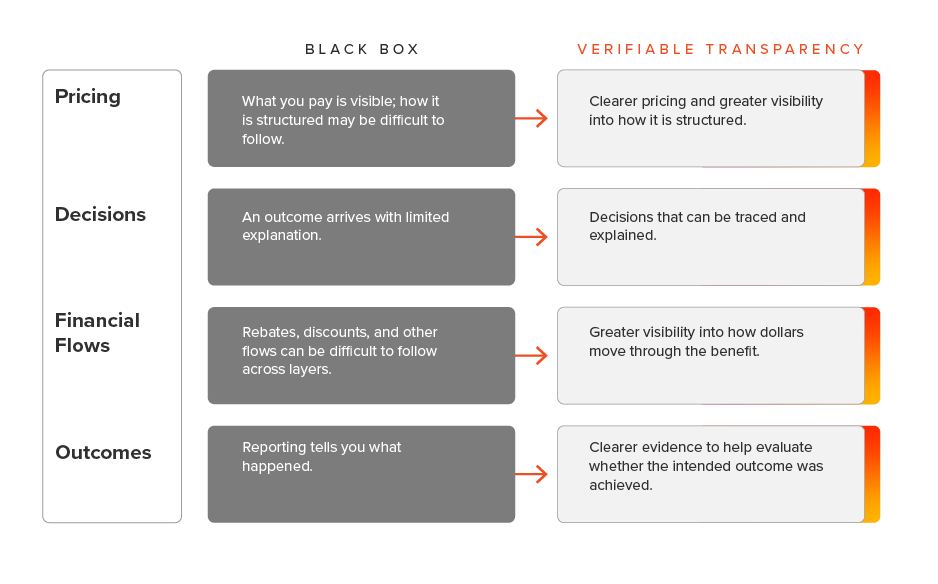
Follow the logic
In Darwin, transparency takes concrete form through Darwin PAth.
PAth reconstructs pharmacy prior authorizations as they move through the decision and visualizes the logic path behind them. Instead of treating an outcome as the end of the story, it helps make the path that produced that outcome easier to follow.
Every decision is traceable. All the rejections are explainable. Every what-if testable.
That makes transparency something more useful than disclosure. It becomes a way to investigate, understand, and ask better questions.
For a health plan, the shift is significant: from receiving an answer to being able to follow the logic behind it.
From “trust us” to “see for yourself”
And transparency keeps evolving. Darwin Tracer laid the foundation by tracking claims through multiple decisions and modules, so the logic behind each outcome can be documented and explained. Today, Darwin Context, the platform’s intelligent information layer, connects Abarca’s data across all domains so that users and apps alike can understand any relevant code, configuration or documentation to make more informed decisions, and Charlie, Darwin’s assistant, makes that visibility easier for every user to reach, answering questions about a claim or a decision in plain language.
Next, Darwin Predict, a predictive drug trend management model built on Abarca’s proprietary data, is expected to be released in the near future to help surface emerging cost drivers sooner. As AI changes, these solutions will change with it. The commitment to transparency does not.
The market is moving toward visibility
Transparency is no longer simply a brand position. The market around PBMs is moving toward greater disclosure and accountability.
State regulation has increasingly addressed PBM pricing, reimbursement, rebates, fees, licensing, and reporting.
At the federal level, the U.S. Department of Labor proposed a rule in January 2026 that would require PBMs serving employer-sponsored self-insured group health plans to disclose specified compensation and financial arrangements to plan fiduciaries, including manufacturer payments, spread-related compensation, and certain pharmacy recoupments. The proposal would also provide audit rights related to those disclosures.
CMS also requires PBMs contracting with Qualified Health Plan issuers to report specified prescription drug benefit information to HHS, including aggregate rebates, discounts and other price concessions, and aggregate spread-pricing information.
The direction is clear: the ability to explain how value is created, how decisions are made, and how dollars move is becoming increasingly important.
For more than 20 years, Abarca has been building a better way to manage pharmacy benefits. That commitment led to Darwin, a proven, cloud-first pharmacy benefit operating system. Healthcare Intelligence represents its next evolution: building greater intelligence, explainability, and accountability into how the platform works.
Transparency, in that context, isn’t an untested promise. It is part of the continued evolution of a platform built to make pharmacy benefits work differently. And together with LucyRx as Healthcare Revolution Partners, it gives health plans a reason to make the switch with confidence.
From visibility to confidence
Transparency matters because seeing more is only the beginning.
The real value comes when health plans can understand what happened, follow the logic behind it, ask better questions, and act with greater confidence.
That is the shift Healthcare Intelligence is built to enable: from complexity you’re asked to trust to intelligence you can trace, question, and understand.
Through Darwin H/I, from Darwin Context and Darwin PAth to Charlie, transparency becomes something health plans can follow for themselves.
See how Healthcare Intelligence makes transparency traceable and explainable.
Learn more about Darwin H/I by reading related blog posts:
- Prior Authorization, Reimagined
- AI Can Transform Healthcare
- Redesigning Prior Authorization: A Shared Path Forward
Ready to see what verifiable transparency looks like? Talk to our team.
____
About Abarca Health
At Abarca Health, we believe in an Unstoppable Drive for a Better Way. We combine innovative technology and healthcare expertise to make pharmacy benefit management more seamless and personalized. From AI and predictive analytics to specialty pharmacy solutions, we transform complex challenges into opportunities and deliver PBM like no one else.
Following the strategic combination with LucyRx, Abarca now operates as a wholly owned subsidiary of Healthcare Revolution Partners, strengthening its scale and capabilities across commercial and government markets.
Discover how Abarca is helping shape a better future for healthcare.
Last Updated on October 26, 2026