
Why prior authorization needs smarter design, not just faster technology
Every clinician can picture the moment. A patient is in front of them, or on the phone, and the treatment decision is already made: the right therapy, chosen for the right reasons. Then the prescription hits a wall. Not a clinical wall; an administrative one. Prior authorization. And in that instant the clinical work stops and a second, entirely different kind of work begins: forms, portals, faxes, phone calls, and a wait measured not in minutes but in days.
Prior authorization was never meant to feel this way. It exists for a defensible reason: to make sure the right patient gets the right therapy at the right time, and to guard against genuine cost and safety risk.
Few clinical leaders would argue with that purpose. What they argue with, rightly, is the experience the current design produces: a process that too often obstructs the very care it exists to protect. The problem isn’t that clinical review exists. It’s that its design has drifted far from its clinical intent.
A design problem, not a villain
It’s tempting to cast prior authorization as the antagonist of modern medicine. That framing is satisfying, and it’s wrong. Utilization management exists because resources are finite, evidence evolves, and some decisions genuinely benefit from a second set of eyes. Used surgically, it protects patients and preserves affordability. The trouble is that it is no longer used surgically.
Somewhere over the past few decades, prior authorization stopped being a targeted clinical checkpoint and became a blanket administrative tax. Routine, well-understood, low-variance decisions are subjected to the same friction as genuinely complex ones.
Clinicians spend valuable time not debating difficult cases but navigating basics, re-submitting information they’ve already supplied, chasing criteria that vary by plan and change without notice. That’s not clinical rigor. It’s a system that can’t tell the difference between what’s obvious and what’s uncertain, and forces everyone to pay the cost of that confusion.
Seen this way, the fix isn’t to abolish review or simply to speed it up. It’s to redesign it, so that the system itself can distinguish the routine from the exceptional, and so that human judgment is spent where it actually changes outcomes.
The human consequences
Design problems in pharmacy don’t stay abstract. They land on people.
When authorization stalls, patients may face delays in starting treatment, additional steps before accessing a prescribed therapy, or added friction in an already difficult care experience. For someone newly diagnosed — frightened, uncertain, waiting — that delay isn’t an inconvenience. It’s part of the illness experience.
Clinicians absorb the burden from the other side: the administrative hours, the peer-to-peer calls, the uncomfortable position of explaining and defending a denial they didn’t author and often can’t fully trace. And with every opaque decision, trust erodes a little more, between provider and plan, between patient and care team.
Prior authorization sits at the intersection of everyone’s competing incentives, and when it fails, it is a failure of trust as much as of process.
This is precisely why prior authorization is worth solving well rather than merely digitizing. Making a broken process electronic — a faster fax, a slicker portal — moves paper more quickly but leaves the underlying design untouched. You end up with the same maze, rendered in higher resolution.
The real opportunity isn’t to accelerate the maze. It’s to replace it with intelligence.
From compliance bottleneck to clinical intelligence
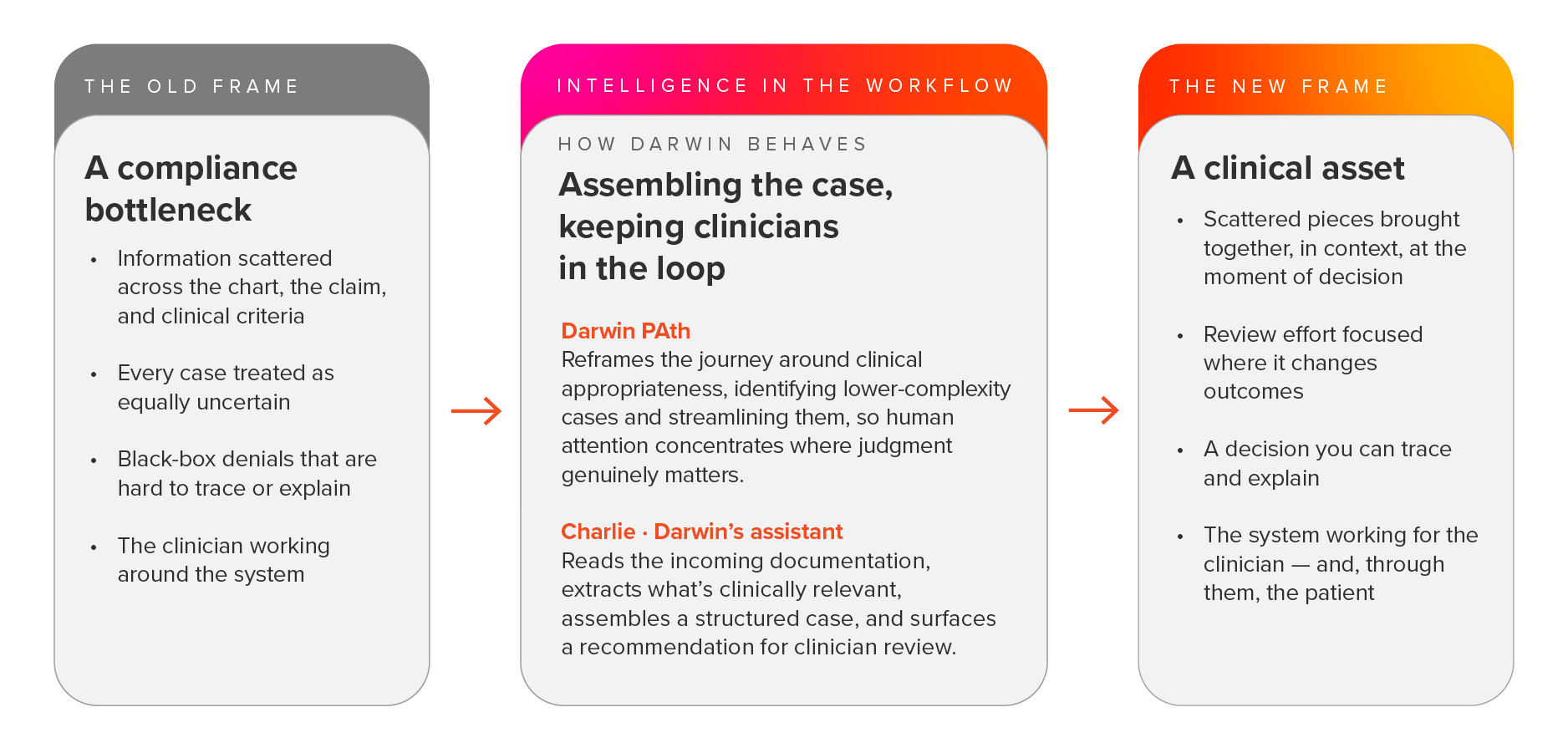
Healthcare Intelligence changes the frame entirely. It doesn’t treat prior authorization as a gate to defend or a queue to process faster. It treats it as a clinical-intelligence problem, and once you see it that way, the solution looks different. Much of the information needed to support the right decision may already exist across the chart, the claim, and the clinical criteria.
The challenge is that it can be scattered, unstructured, and slow to assemble by hand. Intelligence built specifically for pharmacy can bring those pieces together, in context, at the moment the decision is made. When intelligence moves through the workflow, scattered information becomes clearer, more actionable, and available where judgment matters most.
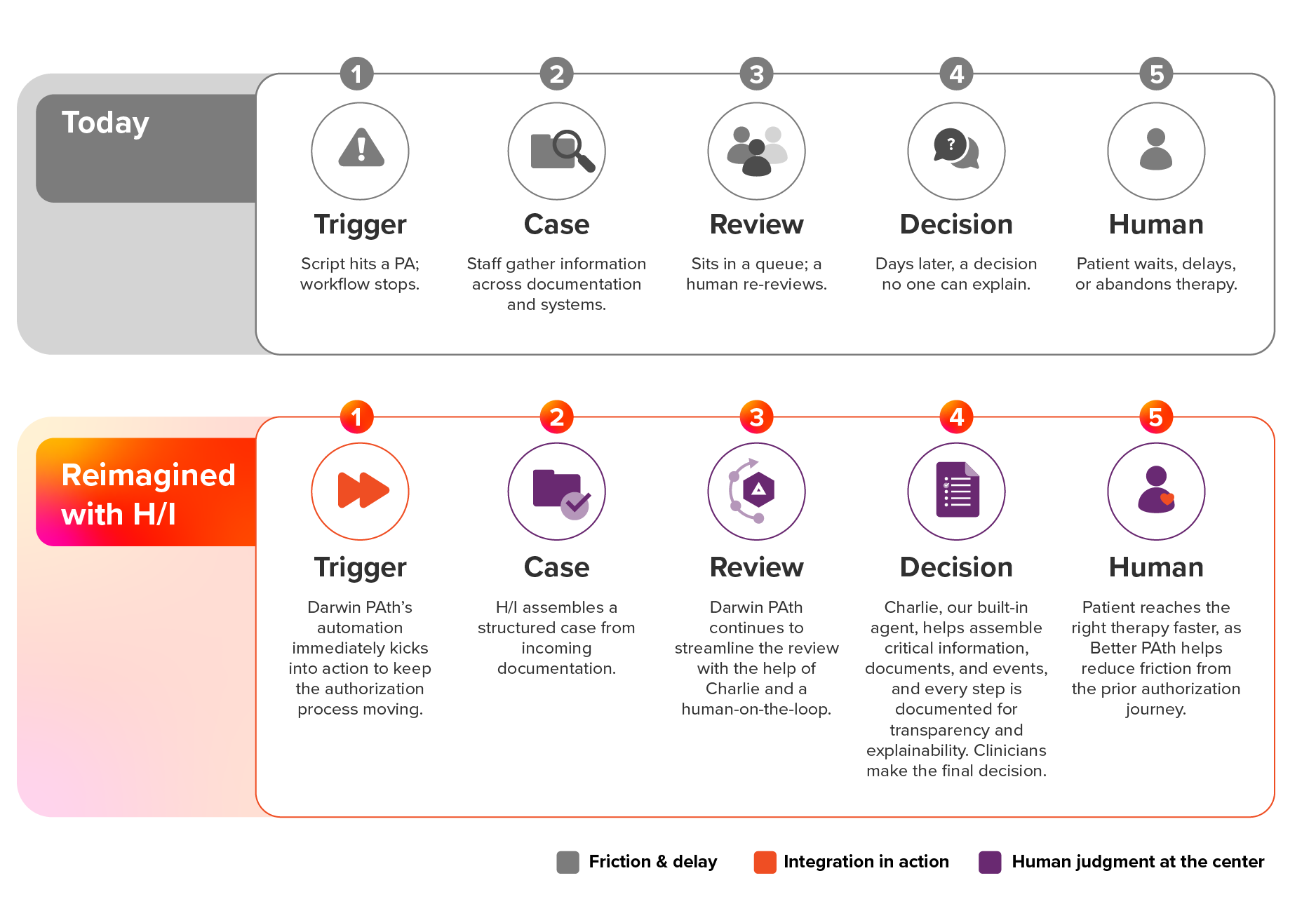
In Darwin, that conviction shows up in how the platform is designed to behave. Darwin PAth reframes the prior authorization and coverage determination journey around clinical appropriateness rather than administrative gatekeeping, and it is enabling the evolution of our Better Care Program to deliver savings: it identifies lower-complexity cases and streamlines them, while keeping clinicians in the loop to make final decisions.
And Charlie gives clinical users an easier interface to Darwin, bringing the relevant information into view while keeping people in control. This is the distinction that matters most: automation with accountability, intelligence with a human in the loop. The clinician is faster and better-informed, never bypassed.
What smarter prior authorization means for clinical leaders
For a clinical leader, the difference is tangible. Instead of a black-box denial, a decision you can trace and explain. Instead of every case treated as equally uncertain, review effort focused where it changes outcomes. Rather than the clinician working around the system, the system working for the clinician, and, through them, for the patient. That is what it means to move prior authorization from a compliance function to a clinical asset.

Darwin PAth is also a good example of how Healthcare Intelligence evolves. It builds on earlier work, from automation that took repetitive steps out of operations to Darwin Tracer, which tracks claims through multiple decisions and modules, so the logic behind each outcome can be documented and explained. And it will keep evolving as we learn from each authorization.
That is Darwin’s ethos: constant evolution.
What this asks of clinical leaders
Reimagining prior authorization is a design commitment as much as a technology one. It means asking, of each rule and each step, whether it still serves the patient or merely persists out of habit, and being willing to retire the steps that no longer earn their place. Clinical leaders are uniquely positioned to press that question, because you see both sides: the legitimate need for oversight, and the human cost when oversight curdles into obstruction.
Healthcare Intelligence gives that instinct somewhere to go. It’s intelligence designed to be transparent enough to trust, accountable enough to defend in front of a regulator or a patient, human enough to keep clinicians at the center of the decision, and bold enough to question the steps that no longer earn their place.
Is your PA process smarter, or just more digital?
Reimagining PA starts with looking closely at the process you have today: where friction is necessary, where it isn’t, and whether technology is actually making clinical decisions clearer or simply moving the administrative burden around.
We created a practical checklist for clinical leaders to help start that assessment. Use it to take a fresh look at your current PA experience. You can also identify where smarter design could make a meaningful difference.

The bottom line
Prior authorization doesn’t need to be abolished; it needs to be redesigned around the people it affects. Treated as a compliance bottleneck, it will keep generating friction and eroding trust. Treated as a clinical-intelligence opportunity, it becomes something better: a faster, clearer, more humane path to the right therapy.
That’s what Healthcare Intelligence is designed to make possible through Darwin H/I, and, as part of Healthcare Revolution Partners with LucyRx, at even greater scale.
Explore how we are redesigning prior authorization
Interested in understanding how Abarca is transforming prior authorization? Reach out to our team today.
_____
About Abarca Health
At Abarca Health, we believe in an Unstoppable Drive for a Better Way. We combine innovative technology and healthcare expertise to make pharmacy benefit management more seamless and personalized. From AI and predictive analytics to specialty pharmacy solutions, we transform complex challenges into opportunities and deliver PBM like no one else.
Following the strategic combination with LucyRx, Abarca now operates as a wholly owned subsidiary of Healthcare Revolution Partners, strengthening its scale and capabilities across commercial and government markets.
Discover how Abarca is helping shape a better future for healthcare.
Last Updated on October 22, 2026