
“Why?” One case, step by step, and what a clear answer requires.
A member hands a prescription to the pharmacist and hears: “This needs prior authorization.” Whether the plan later approves, denies, or pauses the request, everyone involved eventually asks one question: why? It might come from that member, a prescriber waiting to start therapy, a clinical reviewer, or a regulator looking at the process. For a health plan, how well it answers that question says a lot about how its process was designed.
What Is Prior Authorization for Medication?
It’s a review of whether a therapy meets a plan’s clinical and coverage requirements before coverage begins. But a status alone, whether approved, denied, or pending, doesn’t explain the reasoning or tell someone what to do next.
One Illustrative Case
The following example illustrates what an explainable prior authorization for medication process should make visible. It does not describe a real member, prescriber, or case.
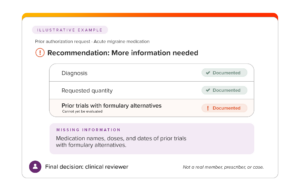
A request for an acute migraine medication arrives by fax. The documentation includes a diagnosis and prescription details, but no record of prior trials with formulary alternatives required by this illustrative plan.
The question is specific: Has the member tried those alternatives, or is that information simply missing from the request?
In Prior Authorization, Reimagined, we explored how the workflow changes. Here, we follow one request through to its final determination and the explanation each person needs along the way.
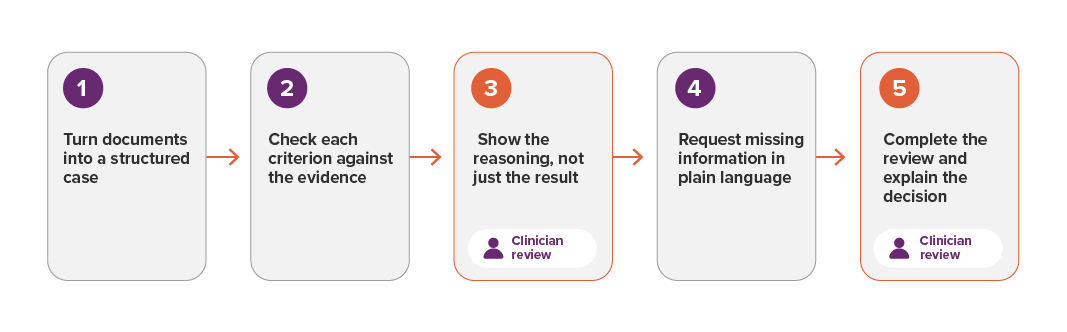
1. Turn Documents into a Structured Case.
The fax, the prescription details, and the member’s pharmacy claims history come together in a single case. No one has to search across systems to find them.
The record distinguishes documented information from information that still needs confirmation. A missing treatment history is an information gap; it does not establish that the member has not tried the required alternatives.
2. Check Each Criterion Against the Evidence.
The review evaluates the plan’s clinical criteria one at a time: Does the record document the diagnosis? Is there a record of trials with formulary alternatives? Does the requested quantity fit plan limits?
Each check is recorded as it happens, so it can be reviewed later.
In this case, the record supports the diagnosis and quantity requirements. However, the review cannot yet evaluate the prior-treatment requirement.
3. Show the Reasoning, Not Just the Result.
In every case, clinicians show and document the reasoning behind a recommendation or decision. Here, the recommendation is “more information needed,” with the reasoning attached: which criterion cannot yet be evaluated, what information is missing, and what documentation would allow the review to continue.
Some cases are prepared with help from Charlie, Darwin’s assistant; others are not. Either way, a clinical reviewer documents the reasoning and confirms the need for additional documentation.
4. Request Missing Information in Plain Language.
Instead of a code, the prescriber and the member each learn what’s missing and what happens next.
To the prescriber: “This request needs documentation of prior trials with formulary alternatives: names, doses, and dates. Once we receive it, we will review the request again.”
To the member: “We need information from your doctor about medications you have already tried before we can finish reviewing coverage for your prescription. We’ve contacted your doctor to request it.”
5. Complete the Review and Explain the Decision.
Then the prescriber submits the treatment history. In this illustrative case, it documents prior trials that satisfy the plan’s requirement. A clinical reviewer evaluates the additional evidence, confirms that the case meets the applicable criteria, and approves the request. When intelligence is used, AI can organize the information and support a recommendation; the clinician makes the final decision.
As a result, the case record links the approval to its evidence and names the reviewer who made the determination.
To the prescriber: “We approved the request. The submitted treatment history documents the required trials with formulary alternatives. The diagnosis and requested quantity also meet the plan’s criteria.”
To the member: “We approved your prescription for coverage. Please contact your pharmacy to arrange your medication and confirm any cost you may need to pay.”
The explanation closes the loop: what was missing, what changed, and why the reviewer approved the request.
Why Now
In April 2026, CMS proposed expanding electronic prior authorization requirements for drugs. If finalized, the proposal would also require specified payers to provide requesting providers with a specific reason for denying drug prior authorization requests. Its electronic prior authorization requirements for drugs have a proposed compliance date of October 1, 2027.
When CMS published the proposal, Abarca was already providing the complete rationale and specific reasons for drug prior authorization denials, so no process changes were needed.
The proposal reinforces a practical expectation: an answer needs enough detail for the recipient to understand it and take the next step.
What It Takes to Answer “Why?”
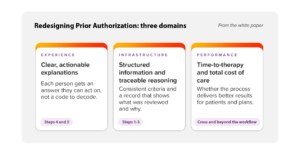
At Abarca Forward 2026, leaders from across the healthcare ecosystem explored how prior authorization can better support timely access to appropriate care. The resulting white paper, Redesigning Prior Authorization: A Shared Path Forward, presents six guiding principles for prior authorization reform across Experience, Infrastructure, and Performance.
The case above puts two of those domains into practice. Structured information supports the review, and clear communication helps people act on it. The third, however, asks whether that process delivers better results. A well-documented decision is valuable. But plans also need to evaluate what happens next, including time-to-therapy and total cost of care.
Questions to Ask Your PBM About Prior Authorization Decisions
- When someone questions a prior authorization for medication, can your PBM show the criteria, evidence, and reasoning?
- Does the record distinguish missing documentation from evidence that the request does not meet a criterion?
- Who makes the final decision, and is that documented in the case record?
- Can members and prescribers get an explanation they can act on?
- When additional information arrives, can your PBM show how it affected the final determination?
What a Clear Decision Should Include
A clear prior authorization case record should show what the reviewer examined and what information was missing. It should also show who made the final determination and what the member and prescriber were told.
Darwin PAth, part of Darwin H/I, delivers efficiencies across the prior authorization and coverage determination process, enabling the evolution of Abarca’s Better Care Program to deliver savings while keeping clinicians in the loop to make final decisions.
Go Deeper
- Read Redesigning Prior Authorization: A Shared Path Forward
- Read Prior Authorization, Reimagined
- Learn more about Darwin H/I
____
About Abarca Health
At Abarca Health, we believe in an Unstoppable Drive for a Better Way. We combine innovative technology and healthcare expertise to make pharmacy benefit management more seamless and personalized. From AI and predictive analytics to specialty pharmacy solutions, we transform complex challenges into opportunities and deliver PBM like no one else.
Following the strategic combination with LucyRx, Abarca now operates as a wholly owned subsidiary of Healthcare Revolution Partners, strengthening its scale and capabilities across commercial and government markets.
Discover how Abarca is helping shape a better future for healthcare.
Last Updated on November 19, 2026