
… but its real value will be measured by whether it makes the system more transparent, accountable, and human
By Greg Archer, Vice President of Product at Abarca
Artificial intelligence is, in my view, the most exciting development we have seen in healthcare and technology in a generation, perhaps in our lifetimes.
Just a few years ago, many of the possibilities we are discussing today would have sounded aspirational. Some might have sounded impossible. But AI is advancing at a pace that is forcing us to reconsider not only what technology can do, but what healthcare itself could become.
That should make all of us pay attention. It should also make us think carefully about the future we are creating.
There is a natural concern that AI will make healthcare less human. People imagine a system in which algorithms replace conversations, machines make decisions, and patients become even further removed from the people responsible for their care.
I believe the opposite is possible. Used responsibly, AI could become one of the most powerful forces for bringing humanity back to healthcare.
Healthcare has dehumanized humans
We have spent decades applying technology to healthcare processes. We have created rules, systems, databases, transactions, and workflows to manage enormous amounts of information and deliver care at scale.
That technology has accomplished a great deal. But it has also left people doing far too much work that does not require the best of what people can contribute.
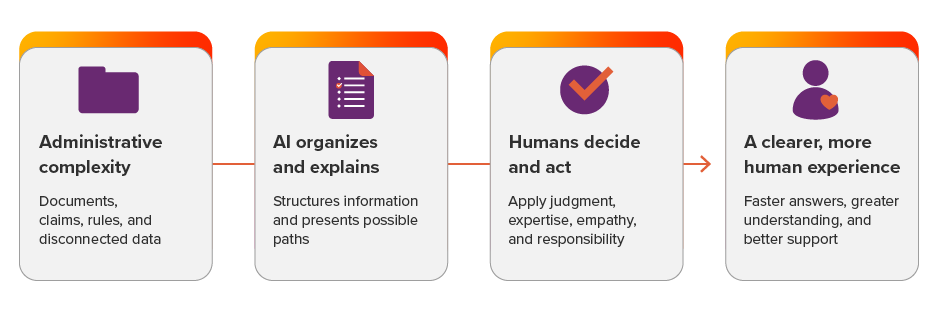
Clinicians spend time searching through documents and organizing information instead of applying their clinical judgment. Administrative teams investigate complicated transactions and manually reconstruct what happened. Patients and providers navigate forms, faxes, portals, rejection codes, and processes that are difficult to understand.
Healthcare professionals have become responsible for managing the complexity of the system while patients experience that complexity at some of the most vulnerable moments of their lives.
This is human toil, but it is not necessarily human work.
Human work is understanding context. It is exercising judgment, listening, explaining, deciding, and acting. It is recognizing that behind every transaction is a person with a health goal, a family, and circumstances that cannot be understood through a code alone.
AI gives us an opportunity to separate the administrative burden from human responsibility. The technology can process the information. It can identify patterns, organize documentation, reconstruct events, and present possible paths forward. Individuals can focus on deciding and acting.
Intelligence must be explainable
The opportunity is extraordinary, but so is the responsibility.
Healthcare cannot operate on answers that no one can explain. An AI model may reach the right conclusion, but in a consequential healthcare workflow, the answer alone is not enough. We need to understand how it got there, what information it considered, and whether the outcome can be verified.
This is especially important when a decision affects whether someone can access a medication.
AI can help analyze documentation, organize clinical information, identify missing elements, and recommend an outcome. But a human must remain responsible for reviewing that work and making the final decision.
The same principle applies throughout healthcare. We run the AI; the AI does not run us.
Every decision should be traceable. All the recommendations should be explainable. Every outcome should be accountable.
Without that foundation, AI may create speed, but it will not create trust. And innovation in healthcare cannot scale without trust.
Imagine what becomes possible
Imagine a world in which changing from one pharmacy benefit platform to another no longer requires months of painful, resource-intensive work.
A health plan could provide its claims history, benefit documents, and other relevant information. AI could organize that material, generate the necessary benefit documentation, identify inconsistencies, and prepare it in a format that people can review and verify. Once approved, much of the configuration and testing could also be automated.
Work that takes months could happen in weeks or even days, not because people have been removed from the process, but because their time is focused on verification and judgment instead of manual configuration.
Imagine prior authorization moving at the speed that patients need.
Information could be extracted and organized as soon as a request is received. Straightforward cases could be prepared for rapid approval. More complicated cases could be directed to the appropriate clinical professional with the relevant information already assembled. Patients and providers could receive understandable explanations without waiting days for someone to draft a letter manually.
Imagine analytics that does not wait for someone to build a report or ask the perfect question.
Instead of looking backward at information from the previous quarter, health plans could understand what is happening in real time. The system could identify emerging issues, explain what is driving them, and model what might happen under different scenarios.
Then people could focus on what they should do about it.
These possibilities are not about making today’s processes slightly faster. They are about reconsidering why those processes exist in their current form at all.
Intelligence built for healthcare
The term “artificial intelligence” has always been difficult for me.
“Artificial” can suggest something fake, detached, or somehow less real. But the impact this technology can have on healthcare is very real. The burdens it can remove are real. The decisions it can support are real. Most importantly, the people whose experiences it can improve are real.
That is why, at Abarca, we use the term Healthcare Intelligence.
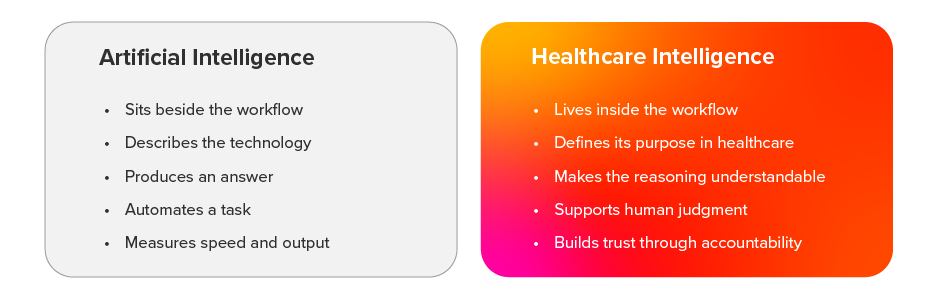
Healthcare Intelligence is not technology for technology’s sake. It is intelligence focused on the problems healthcare actually needs to solve. Also, it understands the context of healthcare, supports the people responsible for delivering it, and keeps human judgment at the center.
It is AI for good
At Abarca, that belief is expressed in four tenets. Transparency, because every decision should be traceable and understandable. Humanity, because behind every claim is a person, not a transaction. Boldness, because the processes our industry has accepted as normal deserve to be challenged. And Accountability, because people must remain responsible for every recommendation and outcome. They are the standard we hold our own intelligence to.
For pharmacy benefits, that means making complicated decisions easier to understand, reducing the friction surrounding access to medications, and giving plans, providers, pharmacists, and patients information they can use.
It means creating a system that is more seamless and personalized because the humans within it finally have the time and tools to make it so. The next phase begins now.

We tend to overestimate what we can accomplish in a short period and underestimate what we can accomplish over a decade. AI may be the exception.
Over the past few years, we have already seen progress that many of us significantly underestimated. The acceleration that will happen this year, next year, and in the years that follow is difficult to imagine.
That uncertainty should not keep us on the sidelines. The organizations that begin learning now will be better prepared to use this technology responsibly as it continues to evolve.
Darwin H/I: a continuous evolution
At Abarca, Darwin H/I is how we are turning this vision into action, and it did not start yesterday. We began leveraging machine learning models before the generative AI explosion, used automation to remove repetitive work from operations, and have kept building from there.
Today, Darwin Context, the platform’s intelligent information layer, connects Abarca’s data across all domains so that users and apps alike can understand any relevant code, configuration or documentation to make more informed decisions; Charlie, Darwin’s assistant, makes it easier for people to work with the platform; and Darwin PAth is bringing intelligence to prior authorization so our Better Care Program can deliver savings while keeping clinicians in the loop to make final decisions. It represents our belief that intelligence can help transform pharmacy benefits into a force for greater clarity, accountability, and value.
We are still in the early innings. Challenges, failures, and lessons will come along the way. Meaningful transformation does not happen on the shortest or most direct path.
That is also why we think of Darwin H/I as a continuous evolution rather than a fixed set of products. As the technology changes, our solutions will change with it. Some will evolve into new versions. Others will be superseded by future iterations of Darwin H/I. We are evolving with what we know and with what we discover along the way, which is exactly what the name Darwin was always meant to stand for.
And there has never been a more exciting time to do this work.
A future worth pursuing
Some of what lies ahead may sound ambitious. It may even sound a little crazy. That is not a reason to dismiss it. The ideas that change industries often sound crazy before they become inevitable.
AI alone will not determine the future of healthcare. It will be determined by how we choose to use it, the safeguards we build around it, and whether we remain focused on the people healthcare exists to serve.
As part of Healthcare Revolution Partners, Abarca and LucyRx now have an even greater opportunity to bring together technology, clinical expertise, and experience to help shape what pharmacy benefits can become, and to give health plans a real alternative when they decide their pharmacy benefit needs to work differently.
AI can make healthcare faster and more intelligent. And if we build it with purpose, it can make healthcare more human. That is a future worth pursuing.
Learn more about Darwin H/I by reading related blog posts:
- Prior Authorization, Reimagined
- Welcome to the H/I Era
- Redesigning Prior Authorization: A Shared Path Forward
_____
About Abarca Health
At Abarca Health, we believe in an Unstoppable Drive for a Better Way. We combine innovative technology and healthcare expertise to make pharmacy benefit management more seamless and personalized. From AI and predictive analytics to specialty pharmacy solutions, we transform complex challenges into opportunities and deliver PBM like no one else.
Following the strategic combination with LucyRx, Abarca now operates as a wholly owned subsidiary of Healthcare Revolution Partners, strengthening its scale and capabilities across commercial and government markets.
Discover how Abarca is helping shape a better future for healthcare.
Last Updated on October 22, 2026