
According to the World Health Organization (WHO), approximately 727,000 people died by suicide worldwide in 2021, accounting for about 1.1% of all deaths globally, the WHO’s latest available global estimates, published in 2025.
Every death by suicide has a ripple effect of devastation, touching families, friends, and entire communities. Social isolation and disconnection can affect mental health and well-being, making it more important than ever to create opportunities for connection and open conversations about suicide prevention. That’s what Suicide Prevention Month, observed every September, and World Suicide Prevention Day, held on September 10th, are all about. As hard as the subject is to talk about, it’s a conversation that needs to happen.
Why Suicide Prevention Month Matters
September 10th: World Suicide Prevention Day
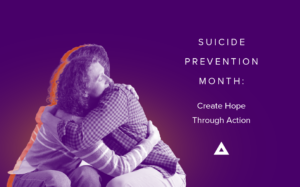
World Suicide Prevention Day is an opportunity to raise awareness of suicide and “Create Hope Through Action,” a message that reminds us all that even the smallest kind gesture or conversation with someone who may be struggling can ignite hope and light in a person going through a very dark moment.
The Centers for Disease Control and Prevention (CDC) identifies connectedness, feeling connected to family, friends, and community, as a protective factor against suicidal thoughts and behaviors. Strengthening social connection can help reduce isolation and support healthier coping.
Suicide Warning Signs and Risk Factors
Suicidal thoughts are complex. The WHO emphasizes that the causes of suicide are multifactorial, shaped by social, cultural, biological, psychological, and environmental factors across a person’s life, not any single cause.
Risk factors are conditions or circumstances that may make someone more vulnerable to suicidal thoughts over time, such as traumatic life events, mental health conditions like depression or anxiety, or a lack of access to support.
Warning signs are more immediate indicators that someone may be at risk right now. According to NIMH, these can include:
- Feelings of hopelessness
- Feeling like a burden to others
- Withdrawing or feeling isolated
- Significant changes in behavior
- Increased use of alcohol or drugs
- Talking about or looking for ways to die
Mental health conditions like depression and anxiety can be part of the picture, but they don’t tell the whole story; suicide risk isn’t a simple, direct line from one condition to an outcome. Recognizing the range of factors involved is part of what makes early, compassionate conversations so important.

How to Support Someone Who May Be Struggling
Often, people experiencing suicidal thoughts may feel like there is no other option, that they are alone, or that they are a burden to their friends and family. Simply showing someone that you care can make a world of difference.
Stigma remains a major barrier to people seeking help. All of us can play a part in changing the narrative around suicide by promoting hope and creating a more compassionate environment where people feel comfortable coming forward.
5 Action Steps to Help Someone Having Suicidal Thoughts
NIMH outlines five concrete steps anyone can take to support someone who may be struggling:
- Ask: Don’t be afraid to ask directly if someone is thinking about suicide. NIMH notes that asking someone if they are suicidal does not increase suicidal thoughts or behavior, and it can open the door to an important conversation.
- Be there: Listen without judgment and let the person know they don’t have to face what they’re experiencing alone.
- Help keep them safe: If someone is in immediate, life-threatening danger, call 911. For crisis support that isn’t a life-threatening emergency, help connect them with 988, the Suicide & Crisis Lifeline, or another appropriate resource. Taking their concerns seriously and helping them find the right level of support can make a critical difference.
- Help them connect: Encourage them to reach out to a mental health professional, a trusted person, or a crisis resource.
- Follow up: Checking in afterward reinforces connection and shows that support doesn’t end after one conversation.
Suicide Prevention Resources and Crisis Support
Educational resources
- For suicide prevention resources, visit the Suicide Prevention Resource Center.
- To learn more about suicide warning signs, risk factors, and treatment options, visit the National Institute of Mental Health website.
If you or someone you know is in crisis
- Call or text 988 to reach the 988 Suicide & Crisis Lifeline, or chat online at 988lifeline.org. The service is free, confidential, and available 24/7 across the United States and its territories.
- Spanish-language support is available by calling 988 and pressing 2, or by texting AYUDA to 988.
- For Veterans, Service Members, and their loved ones: Call 988 and press 1, text 838255, or use the online chat to connect with the Veterans Crisis Line, available 24/7/365.
If there is an immediate, life-threatening emergency, call 911.
How Abarca Supports Mental Health Awareness
As part of our mission for better care, Abarca goes all in during Suicide Prevention Month to raise awareness of suicide prevention, helping reduce the stigma around mental health and encouraging well-informed action that can help save lives and reduce instances of suicide globally.
____
Sources: World Health Organization, National Institute of Mental Health, Centers for Disease Control and Prevention, 988 Suicide & Crisis Lifeline.
____
Originally published September 1, 2022.
Updated September 3, 2026.
____
About Abarca Health
At Abarca Health, we believe in an Unstoppable Drive for a Better Way. We combine innovative technology and healthcare expertise to make pharmacy benefit management more seamless and personalized. From AI and predictive analytics to specialty pharmacy solutions, we transform complex challenges into opportunities and deliver PBM like no one else.
Following the strategic combination with LucyRx, Abarca now operates as a wholly owned subsidiary of Healthcare Revolution Partners, strengthening its scale and capabilities across commercial and government markets.
Discover how Abarca is helping shape a better future for healthcare.
Last Updated on October 14, 2026